
5×5 risk assessment matrix to prioritize risks with clarity
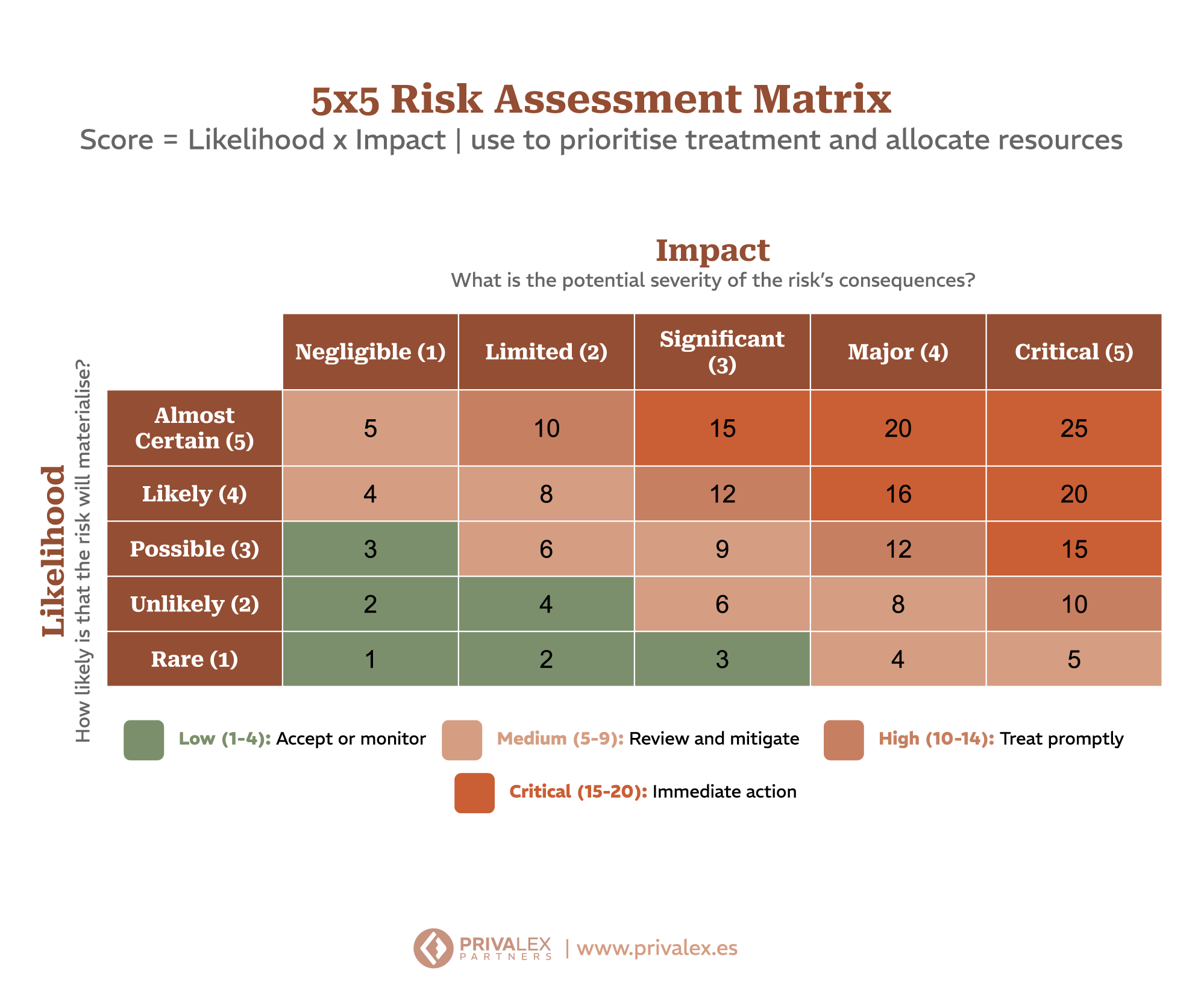
Use the 5x5 risk assessment matrix to evaluate likelihood and impact, prioritize risks with clarity, and support faster, more effective decision-making across your organization.
A 5x5 risk assessment matrix turns "we have risk" into repeatable decisions. It does this by scoring two variables, likelihood and impact, and creates a simple map to prioritize action.
What a 5x5 risk assessment matrix is (and when to use it)
A 5x5 risk assessment matrix is a visual way to value risks. It assigns values 1 to 5 for both likelihood and impact. The intersection defines the risk level per cell. It is useful when you need consistent assessments across teams, and a prioritization method that is understandable for leadership.
It is not magic, it is discipline. A 5x5 matrix works only when it is connected to your process: you define criteria, you assess risks, you decide treatments, and you record evidence. If any of those parts are missing, the matrix becomes a "nice picture" without governance value.
Before you fill cells, you need assets in scope (systems, data, or processes), scenarios with relevant threats and vulnerabilities, and a list of existing controls, so likelihood is not based on gut feeling.
Why it aligns with ISO 27001 risk assessment expectations
ISO 27001 requires that risk assessment is consistent, documented, and reviewed. The core idea is to define risk assessment criteria and ensure evaluations remain comparable over time. In practice, this means you cannot reinvent the scales for every evaluation. A 5x5 matrix helps standardize how you rate likelihood and impact.
Auditors usually do not stop at the final score. They ask why a value is a 4 and not a 3, and how you ensure the same criterion tomorrow. A strong answer is traceability: criteria, assumptions, and evidence. Your matrix must lead to action, if results never translate into treatments, owners, and review cycles, you lose the point of the exercise.
How to define likelihood and impact scales (1 to 5)
The goal is not to add numbers. The goal is that each number has a meaning you can justify. The practical rule: every value needs a short definition, an observable signal, and a simple example. That prevents each evaluator from filling with their own experience and breaking comparability.
Likelihood reflects how likely a scenario is. Instead of "high or low," define observable signals: frequency, exposure, history, and existing controls.
Impact reflects consequences for confidentiality, integrity, and availability. Impact definitions usually work better when split into confidentiality (data exposure), integrity (unauthorized changes or loss of correctness), and availability (service outage or sustained degradation).
For each level, document briefly what it means, what evidence supports it, and what you expect to happen if the scenario materializes. That creates traceability.
How to fill a 5x5 matrix without intuition
Filling cells is where bias appears. To reduce that risk, use a repeatable procedure: select the exact scenario and scope; list existing controls and the evidence that supports them; assess likelihood using documented criteria; assess impact using defined ranges and the CIA link; assign scores and apply the agreed calculation method; and record assumptions and short justifications so the result stays replicable.
A cell is not filled for a generic "risk," it is filled for a specific scenario affecting assets in your scope. Avoid deciding based on perception, request evidence: current controls, recent changes, incidents, and operational signals. If you lack enough evidence, the result should explicitly reflect uncertainty.
How to convert scores into treatment plans
A matrix is not the plan, it is a filter for prioritization. Define thresholds before you look at the matrix: for example, very high cells require immediate mitigation, medium cells need a follow-up plan, and low cells are handled via maintenance. Then the discussion becomes about evidence and ownership, not personal opinions.
For each prioritized risk, define treatment fields: controls to apply and why, responsible team, target date, verification mechanism, and review date. When audit time arrives, you do not have to guess, you can show the full chain from scenario to score to decision to executed evidence.
Minimum register template
Keep at least: scenario and affected assets; probability and impact criteria used; resulting score and a short rationale; tolerance decision (accept, mitigate, transfer); treatment plan (controls, owners, dates); expected evidence and how it will be verified; and the next review date or trigger.
How to keep the matrix reviewed
A matrix that is never reviewed becomes a history file. Audits typically expect consistency between plan and reality. Review the matrix when there are changes in systems or processes, incidents with lessons learned, and changes in scope, and also schedule periodic reviews to support continuous improvement.
Many teams start with a formal annual review and micro-updates after relevant changes or tabletop exercises. Before you approve updates, verify: consistency of definitions, coherence between scoring and available evidence, and consistency of decisions.
To keep traceability, version your matrix. Every relevant change should explain what changed, why it changed, and which scenario or date it applies to. To keep the matrix consistent across teams, calibrate interpretation: pick a few realistic scenarios and ask multiple teams to score them using the same criteria, then compare results and adjust definitions where the gap comes from unclear wording rather than evidence quality.
Common mistakes that can block progress
Using the matrix without documented criteria. If "likelihood 3" is undefined, the matrix becomes just a visual. That is the difference between having a matrix and having a control.
Letting different teams interpret the same cell differently. If interpretation differs, risk levels are not comparable, weakening consistency across time.
Keeping the matrix static even when the risk changes. If the context changes but the matrix does not, the method contradicts operations, and the matrix becomes a snapshot rather than a living control.
Not linking scores to treatment plans and evidence. Without treatment and decision records, the matrix does not guide action, and the control story is incomplete for audit.
How CB Partners can help
We help you design a risk assessment process that is consistent, documented, and usable by teams. We support defining criteria and scales per scope, turning scores into treatments with owners, and keeping traceability ready for audit conversations. We also help you turn the matrix into a management asset: shared templates, clearer assumptions, and a review flow the team can sustain.
Frequently Asked Questions
What is a 5x5 risk assessment matrix and why is it useful?
It is a 1-to-5 likelihood and impact scoring approach that helps prioritize and keep assessments consistent across evaluators. In audits, the key is proving the method is repeatable, defensible, and connected to treatment and evidence.
How do you define scales in a 5x5 matrix?
By documenting criteria with observable signals: control maturity, incident history, and consequence ranges for your assets. Each number should be explainable in one short statement and backed by observable signals or ranges.
Is a 5x5 matrix required for risk assessment?
ISO 27001 does not force one single representation. The key is consistency and documented criteria. A 5x5 matrix can be a practical option; if your current approach already yields consistent results, you can keep it.
How do I turn a cell into treatment actions?
Use it to prioritize under your risk tolerance, then define controls, owners, timelines, and review mechanisms as evidence of execution, including an identifiable owner, a target date, and a verification method.
How often should the matrix be reviewed?
At least according to your review schedule and whenever the context changes. Incidents and relevant change events typically trigger an update, alongside real learning: near-misses, scope changes, and changes in control effectiveness.
What evidence should be kept from a 5x5 matrix for audit?
Keep the methodology and criteria, the calculated results, the link to treatments, and references in your management system documentation. The auditor should be able to follow the thread: scenario evaluated, score assigned, decision made, and evidence showing execution.
Ready to talk about your compliance roadmap?
Tell us which frameworks apply to you and we'll scope an engagement within days.